Certificates | الشهادات الاحترافية
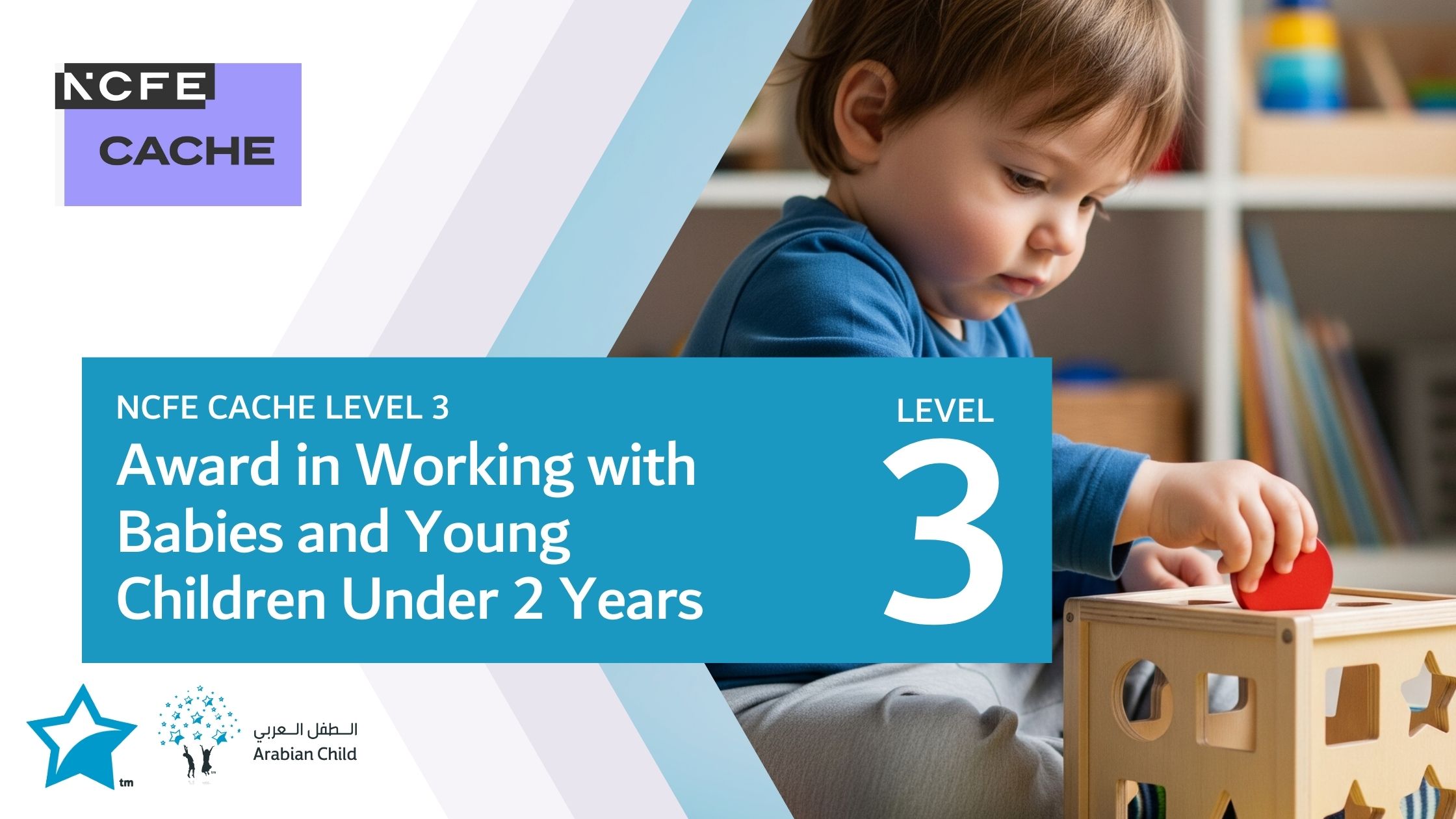
NCFE CACHE Level 3 Award in Working with Babies and Young Children Under 2 Years
Original price was: د.إ3,500.00.د.إ2,500.00Current price is: د.إ2,500.00.
🌱
NCFE CACHE Level 3 Award in Working with Babies & Young Children Under 2 Years
NCFE CACHE Level 3 Award in Working with Babies & Young Children Under 2 Years
👶 Build your expertise in infant care and early development!
Learn how to create nurturing, responsive, and safe environments for babies under 2 — covering
EYFS care standards, attachment theory, and holistic development.
💼 For early years practitioners or volunteers already working with infants.
Workplace-based
UK-accredited by NCFE CACHE
🛡️ Your Information Is Fully Protected
🔒 Trusted & Secure Online Shopping Experience
Continuing Professional Development Course
CACHE Level 3 Certificate
Working with Babies and Children Under Two Years
Working with Babies and Children Under Two Years
NCFE CACHE LEVEL 3
ARABIAN CHILD
ARABIAN CHILD
A specialist internationally accredited program that helps practitioners working with babies and children under two provide outstanding care and education.
40 Hours
Guided Learning
1 Month
Duration
4 Sessions
Online
Arabian Child
A professional Arab-focused program designed to support best practices in early care and education during the most important stages of human development.
Accreditation and Professional Alignment
A trusted program aligned with recognized professional standards in the region.
✓ Aligned with ECRA accreditation and global classification standards
✓ International accreditation from NCFE CACHE
✓ Accredited by KHDA in the United Arab Emirates
✓ Accredited by TVTC in the Kingdom of Saudi Arabia
Overview
Program Overview
A specialist professional program that develops the skills of practitioners working with babies and young children in early childhood and professional settings.
The CACHE NCFE Level 3 program in working with babies and young children under the age of two is a specialist professional program focused on developing the skills of practitioners working in baby rooms and early childhood settings. It helps ensure high-quality care and education for this sensitive age group, which forms the first foundation in a person’s life.
The program combines strong theoretical knowledge with practical workplace skills, giving practitioners a full understanding of how to support the child’s overall development from the earliest moments of life. The program is based on international EYFS standards and is designed especially for early education settings in the Arab world.
01
Theoretical Knowledge
Regulatory requirements and children’s individual needs within the global EYFS framework
02
Quality of Interaction
Responsive care and sensitive interaction that support emotional and cognitive growth
03
Environment Setup
Designing the learning space and creating a safe, stimulating environment for babies
04
Partnership with Families
Building a strong cooperative relationship with families to support ongoing learning
Facts and Research
Why Is the Baby Stage So Important?
The early years are not just a beginning in time. They are the stage where the foundations of learning, security, and connection are built.
Modern scientific research clearly shows that the first three years of a child’s life are the most important and most influential in shaping the brain’s basic structure, and therefore learning, communication, and a sense of security throughout life. These are not just numbers. They are scientific facts that shape our priorities.
80%
Brain Growth
Most human brain growth is completed by age three
1M+
Neural Connection
A new neural connection forms every second in the early years
3
Golden Years
The first three years are the fastest period of brain growth
13x
Return on Investment
For every dollar invested in early childhood
Nurturing care is built on five essential areas that cannot be separated: health, nutrition, safety, responsive care, and opportunities for early learning. This stage is a unique chance to build the whole person.
Learning Outcomes
The Four Learning Outcomes
Connected content that covers understanding the child, care, relationships, and learning during infancy.
1
Understanding the Individual Needs of Babies
EYFS requirements, overall developmental milestones, the impact of pre-birth experiences, partnership with families and specialists, and advocacy for the best interests of the child
2
Holistic Care within the EYFS Framework
Complete physical care: nutrition, safe sleep, physical activity, and hygiene, with sensitive and quick responses to each child’s needs according to their own rhythm
3
Building Warm and Responsive Relationships
Reading the child’s signals, return-and-serve interaction, building trust and emotional security, and the role of the key person
4
Supporting Development and Learning
Using research in daily practice, schematic development, and evaluating and improving indoor and outdoor environments
Developmentally Appropriate Activities
Developmentally Appropriate Activities for Infancy
A supporting section linked to the program philosophy, focusing on age-appropriate learning, responsive care, safe sensory exploration, and daily applied practice.
Safe Sensory Exploration
Providing calm and gradual sensory experiences that respect the child’s sensitivity and ability to explore without overload.
Learning Based on the Child’s Own Rhythm
Matching activities to the child’s signals and daily needs, so learning happens through interaction, care, and daily routines.
Short but Meaningful Experiences
Simple, purposeful activities that focus on positive repetition, language, eye contact, and free, safe movement.
Practice Connected to Real Work
Turning theory into daily practice in the care environment, so that every moment of interaction becomes a chance for growth and learning.
Responsive Interaction
Responsive Interaction Cycle — Return and Serve
An interaction model that shows how every sensitive and purposeful response helps build brain connections and emotional security.
Return and serve is a scientific concept strongly supported by neuroscience. Every interaction between the child and the caregiver is a valuable chance to build a new neural connection. The 1:3 ratio in the program is not just an administrative number. It helps make sure there is enough time and energy for intensive interaction with each child.
1
Child Signal
Crying, a look, or a movement
2
Caregiver Attention
She notices and reads the signal carefully
3
Sensitive Response
She responds quickly, attentively, and kindly
4
Brain Development
Neural pathways and connection develop
5
Repetition and Trust
Repetition strengthens emotional security
Repeating this cycle thousands of times each day — during feeding, diaper changing, and play — is what literally builds the child’s brain. Daily care routines are also powerful learning opportunities.
Infant Room Design
Organizing the Baby Room: A Stimulating Environment
The environment is not just a place. It is an active educational element that supports independence, exploration, and safety.
The physical environment is not just a background for care. It is the third teacher, as described in the Reggio Emilia philosophy. A thoughtfully designed baby room supports independence, encourages exploration, and protects the child’s safety at the same time.
Safe Space for Free Movement
A clean floor prepared for crawling and exploration, away from sharp furniture, giving the baby freedom of natural movement that builds strength and confidence
Quiet Sleep Areas
Approved safe sleep procedures, a calm and soft environment that respects each child’s rhythm, with continuous supervision
Carefully Chosen Materials
Few, safe materials with varied textures and shapes that encourage free exploration without overwhelming the senses. In baby environments, less is sometimes more
A Visually Rich and Balanced Environment
Balanced and thoughtful visual stimulation suited to the child’s stage of development, combining enrichment and calm without overload
Target Audience
Who Is This Program For?
A program designed for practitioners, leaders, and institutions that want to improve the quality of care and education for children under two.
This program is designed especially for practitioners who understand the importance of their work and want real professional growth. The main entry requirement is that the learner is working or volunteering in a real professional setting with this age group, because learning and practice go together.
Teachers and Caregivers
People working in baby rooms and nurseries who are looking for strong professional accreditation to enrich their daily practice
Teaching Assistants
Those working with children under two who want to deepen their understanding and develop specialist professional tools
Supervisors and Leaders
Supervisors in early childhood centers and leaders who want to raise quality standards in their institutions
Educational Institutions
Nurseries and early childhood centers seeking to develop their practices in line with quality standards and international accreditation
Entry Requirement: The learner must be working or volunteering in a real professional setting with children under two during the study period
Assessment Methods
Approved Assessment Methods
A complete assessment approach that combines professional observation, practical reflection, and external quality checking.
The program uses a complete assessment system that combines workplace observation, professional reflection, and external verification. Assessment is not just an isolated theory test. It reflects the depth of understanding and the quality of practice in the real setting.
Direct Observation
In the real work setting — required for all trainees
Professional Discussion
Connecting theoretical understanding with practical workplace application
Reflective Account
Analyzing workplace experience and its impact on improving practice
Expert Witness Testimony
Always supported by a specialist professional discussion — EWT
Grading and Achievement System
The program uses a two-grade system that respects the learning journey and allows continued development:
✅ Achieved
Achieved — successful completion of the required standards
Not Yet Achieved
Not Yet Achieved — opportunity for development and resubmission
The internal professional portfolio is the main record for the program, with strong external quality assurance from the accredited British NCFE body. CPD certification for continuing professional development gives international recognition of your skills and professional excellence.
Free Introductory Webinar
Join the Free Introductory Webinar
Do not miss the chance to learn more about this distinguished program and get direct answers to your questions from the specialists at Arabian Child. The webinar is completely free and open to everyone interested in raising their professional skills in baby care.
Webinar Details
Date Monday — 21 April 2025
Time 5:00–6:00 PM Saudi Time
6:00–7:00 PM UAE Time
6:00–7:00 PM UAE Time
Format Online — completely free
Contact and Registration
UAE +971 58 946 6518
Saudi Arabia +966 53 399 3065
Registration Registration Link
Arabian Child — NCFE CACHE Level 3 Award | QN: 610/5193/7
Your partner in building a learning generation from day one
Register for the free webinar now
Related products
-
Certificates | الشهادات الاحترافية
Comprehensive English: Reading & Writing Skills – In Partnership with Penn Foster University
د.إ3,700.00 Add to cart Buy Now -
Certificates | الشهادات الاحترافية
NCFE CACHE Level 3 Award for Educational Needs Coordinators in Early Years Settings (SENCo)
د.إ4,820.00 Add to cart Buy Now -
Certificates | الشهادات الاحترافية
Advanced Training in Early Childhood Education and Care
Original price was: د.إ2,100.00.د.إ1,785.00Current price is: د.إ1,785.00. Add to cart Buy Now